
What’s new in Mako Core 8.4?
- Improved stability, performance, and rendering accuracy across core workflows
- Apex PDF Output introduced in beta for select customer evaluation
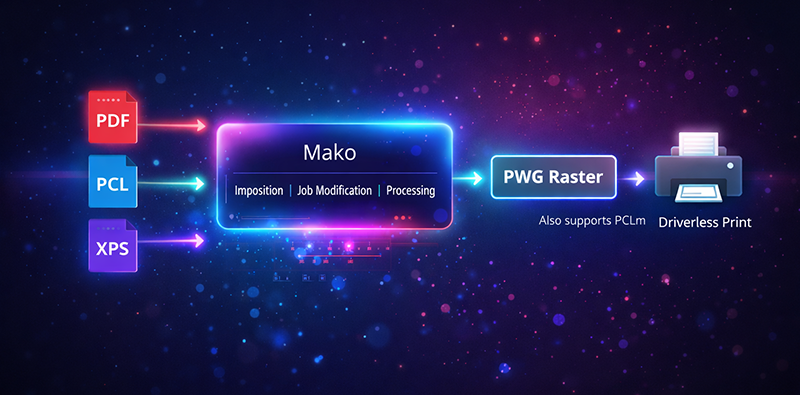
- Support for PWG Raster and PCLm for driverless workflows in enterprise print
Mako Core™ 8.4 is a maintenance-focused release that delivers important improvements to stability, performance, and rendering accuracy, while continuing to lay the groundwork for future innovation across the platform.
A key area of progress in this release is the development of Apex PDF Output, which is now available in a beta capacity to selected customers for evaluation and testing. This capability represents a significant step forward in how Mako generates PDF content, enabling much faster and more efficient workflows. While not yet generally available, the work completed in this release brings the technology close to full production readiness, where it will be formally introduced in Mako 9.0 as part of the broader Apex Performance initiative.
A new output class to write PWG (Printer Working Group) raster directly from any Mako-supported PDL (PDF, PCL, XPS etc.) is introduced in this release. The combination of Mako’s abilities to modify jobs, for example imposing for booklet printing, offers a powerful solution that supports driverless workflows in enterprise print. Another format common to these workflows is PCLm, a PDF-based wrapped-raster format that is already supported by Mako. New sample code is available to show how to do this in the most efficient way.
Alongside this, Mako 8.4.0 delivers a wide range of enhancements to rendering consistency and output quality. Customers should see more consistent results when processing complex documents, including improvements in color handling, transparency, font rendering, and overprint behavior.
This release also addresses several performance and scalability concerns identified in real-world use cases. Improvements have been made to the handling of large and complex files, including optimizations to multi-threaded processing and image handling. These changes help ensure more reliable performance, particularly in high-volume or resource-intensive environments.
A significant number of fixes have been implemented to resolve customer-reported issues and regressions. These include corrections for rendering errors, stability issues, and edge cases affecting PDF and PostScript processing. Together, these fixes improve the robustness of the platform and reduce the likelihood of failures in production workflows.
Overall, this release strengthens the core of the Mako platform, delivering meaningful improvements today while preparing the way for the next generation of capabilities to be introduced in Mako 9.0.
Full notes for this release will be available on Mako’s documentation website on April 1st, 2026.
About the author

David Stevenson is the product manager for the Mako Core™ SDK and responsible for the performance component in SmartDFE™, the AI-accelerated digital front end platform for high-speed, single-pass inkjet presses. Throughout his career, he has specialized in electronic documents, starting with Xerox Corporation as a product manager for Venture Publisher, an early star of desktop publishing on PCs. That was followed by a 13-year career at Adobe, specializing in various aspects of PDF, including creative print workflows, electronic forms and accessibility. At Helix he continues to focus on PDF technology and solutions for page description languages (PDLs).
Further reading:
- See Apex Renderer in action: Multi-page performance with GPU speed
- Mako Core 8.3: Sharper rendering today, faster PDF output tomorrow
- Film: Choosing a print software development kit (SDK)
Be the first to receive our software release updates, blog posts, company and product news. Why not subscribe to our newsletter? Subscribe here