In his latest post, Eric Worrall explains how PCLm fits into Microsoft’s move to driverless printing and the broader changes reshaping the print pipeline.
Printing is going through a major shift, driven by Microsoft’s move toward driverless printing. What sounds like a platform change is actually a deeper architectural one. It changes where rendering happens and what gets sent to printers.
Windows is moving to an IPP-based model, aligned with Mopria and IPP Everywhere, with third-party drivers expected to be phased out around 2027. Instead of device-specific languages, printing is now built around a small set of standard formats.
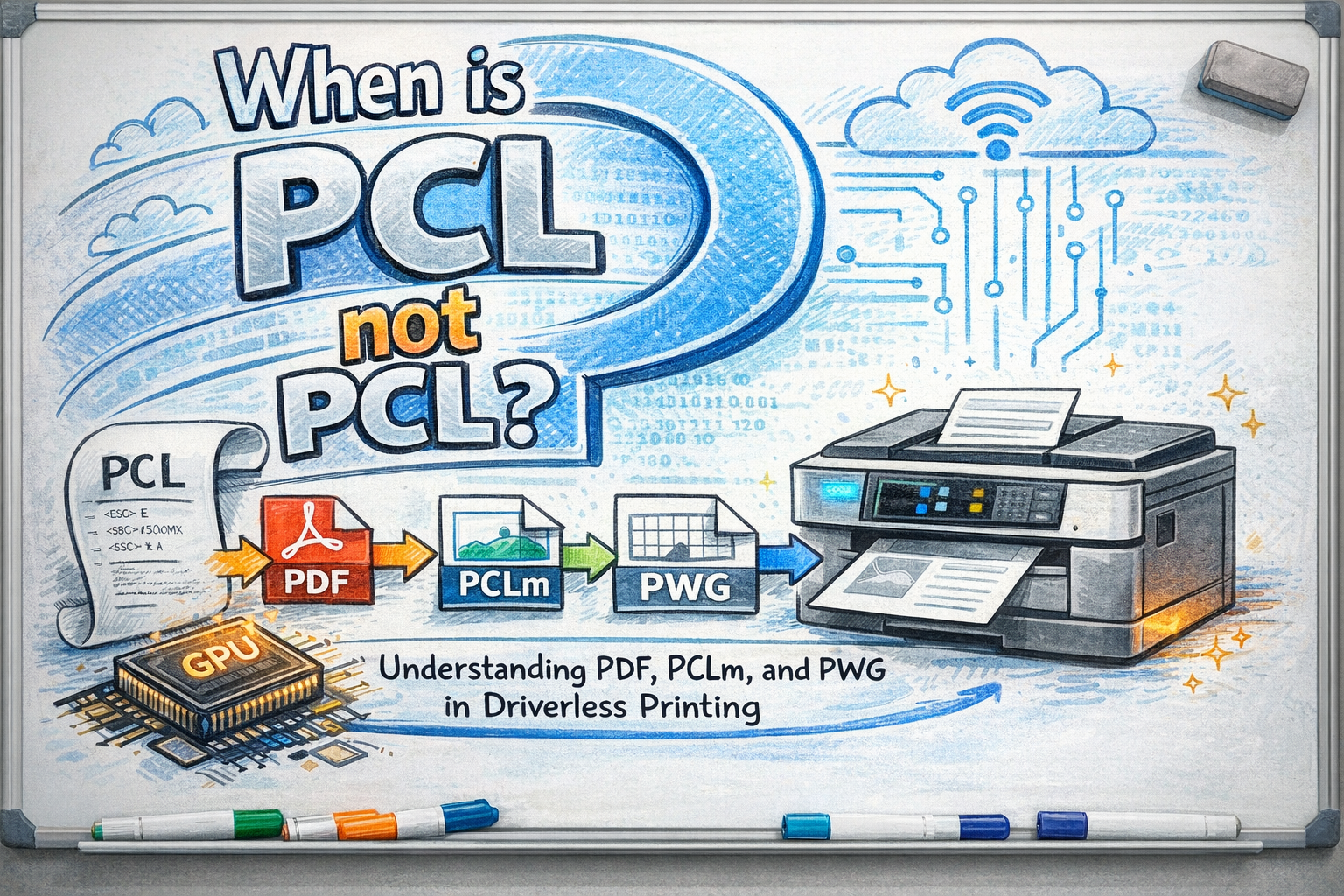
Those formats are PDF, PCLm and PWG Raster. In practice, systems try PDF first for quality and efficiency, fall back to PCLm for simpler devices, and finally use PWG as a guaranteed baseline. That flow defines modern printing.
This is where PCLm becomes interesting. Despite the name, it is not PCL in the traditional sense. Classic PCL is a command language where the printer renders the page. PCLm does the opposite. The page is rendered in advance, converted to a raster image, typically JPEG, and wrapped inside a very simple PDF structure. The printer is no longer interpreting instructions, it is just decoding and printing an image.
The name comes from continuity rather than technical accuracy. It replaces PCL in many workflows and signals an efficient, device-friendly format. In reality, it is much closer to a constrained PDF than to any traditional Printer Command Language.
PCLm exists because many printers cannot efficiently render full PDF. By moving rasterization to the client or platform, the device becomes simpler and more predictable. The trade-off is that rendering is no longer the printer’s job, it is the pipeline’s.
That shift makes performance critical. Modern workflows increasingly involve converting PDF into raster for PCLm or PWG. This is where Mako with Apex fits. By supporting PDF, PCLm and PWG, alongside legacy formats, and accelerating rendering on the GPU, it addresses the new bottleneck directly.
So when is PCL not PCL? When it is PCLm. A format that keeps the name, but reflects a complete change in how pages are delivered and printed.
For more information visit: Mako Core and Apex
About the author

Eric Worrall leads the product management and technical services teams, as well as being responsible for the product strategy, position and vision within Helix. He has a wide experience of key roles including senior software developer, technical support, sales and product management, and has over 25 years of market knowledge in printing, digital documents and machine vision technologies.
Eric Worrall has been with the company since 2004 and leads Product Management and Technical Services, as well as the product strategy, positioning, and vision for Helix.