
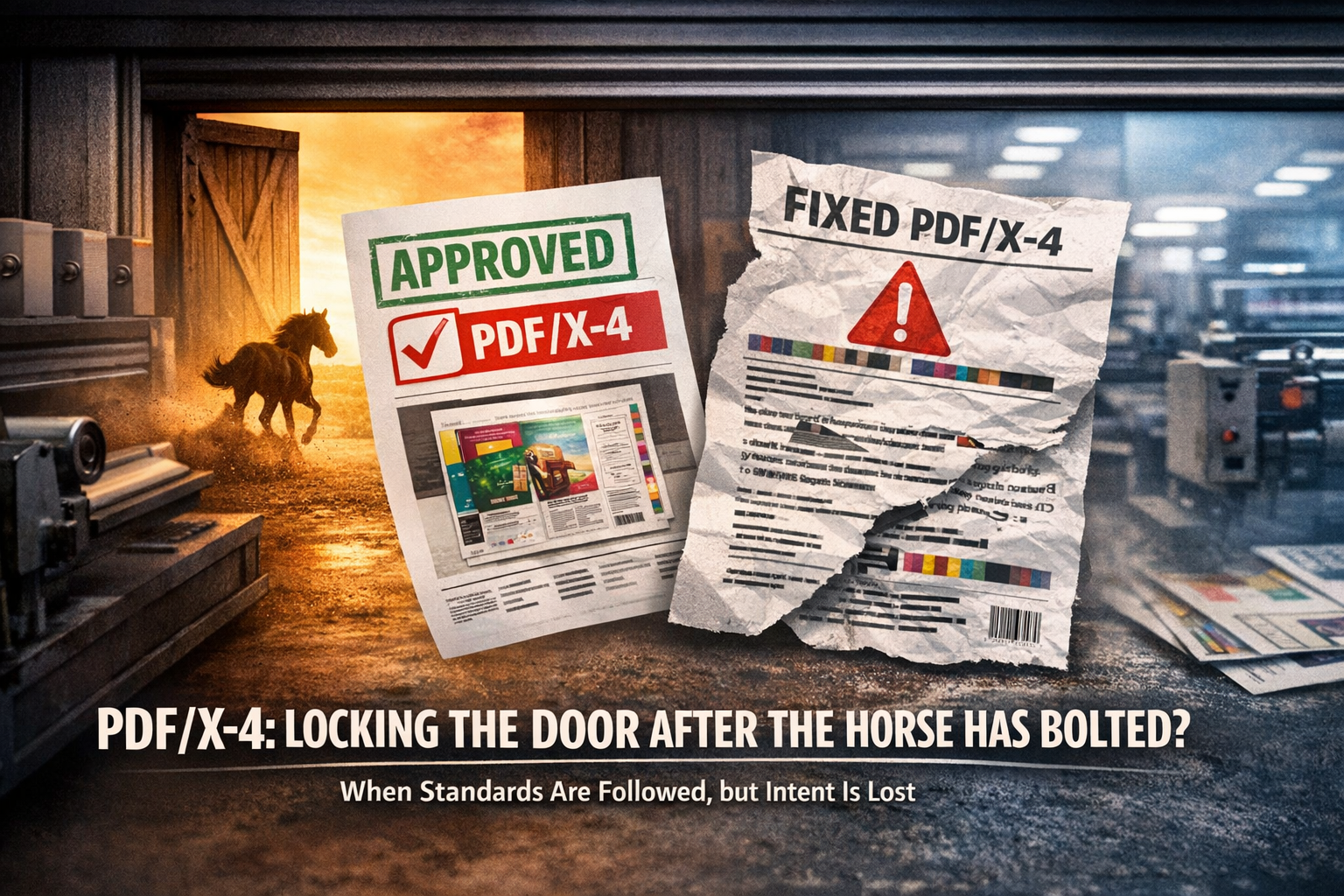
PDF/X-4 has a strong reputation in professional print. It promises predictability, self-containment, and freedom from unpleasant surprises at press time. But in the real world, many printers and brand owners quietly question its value. Why? Because when PDF/X-4 is applied incorrectly, we don’t experience the benefit the “PDF/X” brand implies, and when that happens, trust erodes.
The promise of PDF/X-4
At its core, PDF/X-4 is designed to:
- Ensure all fonts and images are embedded
- Declare the intended print condition
- Remove ambiguity from downstream processing
- Preserve live transparency and color management
- Deliver deterministic rendering
In simple terms, this means that once the file is approved and exchanged, nothing downstream needs to guess. That’s powerful but only if it’s used correctly.
Where things go wrong
In many real-world workflows, PDF/X-4 is created after the customer has already proofed a non-compliant file. The printer then fixes missing fonts, substitutes resources, normalizes the structure and then exports a ‘clean’ PDF/X-4 file. Technically, the file now complies. However, if the content was altered in the process, the original intent may already be compromised. At that point, PDF/X-4 hasn’t locked in the designer’s intent, it has only locked in the modified state. The horse has already bolted.
The result: brand dilution
When a job is rejected and the printer says, “But it was PDF/X-4 compliant,” the customer hears something different: “The file met the rules, but it didn’t match what I approved.” From a technical perspective, PDF/X did its job but from a commercial perspective, it didn’t. That disconnect damages confidence in the PDF/X name. The real issue is governance, not format. PDF/X-4 delivers value only when it is created by the content authority, or under their control, proofing happens on the actual PDF/X file and downstream systems do not alter visual content. If those conditions aren’t met, PDF/X becomes a compliance checkbox instead of a reliability guarantee. The standard doesn’t enforce behavior – workflow discipline does.
Technical determinism vs intent determinism
PDF/X guarantees technical determinism:
- No missing resources
- No undefined color behavior
- No system-dependent rendering
It does not guarantee creative fidelity, for example correct font choice, accurate layout decisions and proper upstream color conversions. Those responsibilities sit earlier in the chain. When we expect PDF/X to guarantee both, disappointment follows.
The bottom line
PDF/X-4 is powerful when it marks the moment of intent lock-in. It is weak when it marks the moment of downstream repair. If applied correctly, it reduces risk and ambiguity dramatically. If applied incorrectly, it becomes little more than a compliance label. The standard isn’t flawed, but its perceived value depends entirely on disciplined workflow application. In print, predictability comes from both structure and governance. PDF/X handles the structure, so the workflow must handle the rest.
Find out more about PDF standards and compliancy on our Mako Core™ web page.
About the author

David Stevenson is the product manager for the Mako Core™ SDK and responsible for the performance component in SmartDFE™, the AI-accelerated digital front end platform for high-speed, single-pass inkjet presses. Throughout his career, he has specialized in electronic documents, starting with Xerox Corporation as a product manager for Venture Publisher, an early star of desktop publishing on PCs. That was followed by a 13-year career at Adobe, specializing in various aspects of PDF, including creative print workflows, electronic forms and accessibility. At Helix he continues to focus on PDF technology and solutions for page description languages (PDLs).
Further reading: