
How PageShooter™ delivers random page access without compromising production speed.
PDFs have an inherent order. Page one is followed by page two, page three and so on. That makes perfect sense when you’re reading a document, and in many conventional print workflows. But what happens when printing is part of an automated manufacturing process and the next thing that needs to be printed isn’t known in advance? And what if you need to print those pages in any order, without slowing down the production line? This is where conventional approaches to print processing can become a limitation.
Increasingly, the next item to be printed may depend on an event happening somewhere else on the production line. A barcode is scanned. An RFID tag is read. A database identifies a customer. A manufacturing control system determines which product has just arrived at the print station. Only then does the printing system know what it needs to print. And in a high-speed manufacturing environment, it needs to respond immediately.
From sequential to event-driven printing
Imagine a PDF containing hundreds or thousands of different pages, each representing a product variant, label, piece of personalized content or other item.
The production line may not require those pages in numerical order. It might need page 237, followed by page 16, then page 804. More importantly, the decision about which page is required may only be made immediately before it has to be printed. Being able to access those pages is one challenge. Being able to RIP them at the same speed as if they were being processed sequentially is quite another.
In industrial inkjet, production speed matters. A printing system that can select any page but takes longer to process it may become a bottleneck, limiting the speed of the entire manufacturing line.
For applications such as product labeling, packaging, card personalization, mail and fulfilment, and track-and-trace, the ability to combine random page access with full production performance can be extremely valuable.
PageShooter™: random access without the performance penalty
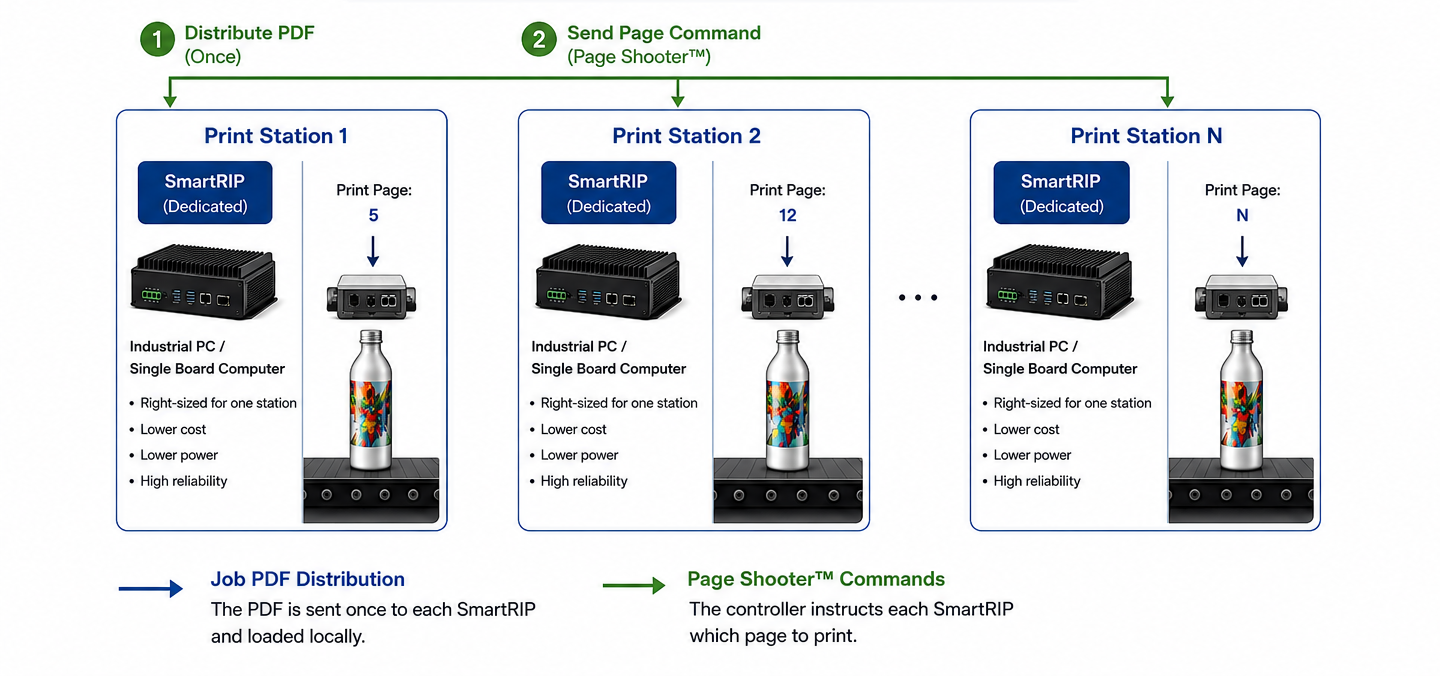
This is precisely what PageShooter™ within SmartRIP is designed to deliver. Rather than treating a PDF as a sequence that must be processed from beginning to end, PageShooter provides random access to individual pages. An external system can request any page within the PDF, and SmartRIP can rasterize that page without having to process all the preceding pages.
But the real innovation is what happens to performance. With PageShooter, RIPping pages in a random order is just as fast as RIPping them sequentially. Whether the production line requests pages 1, 2 and 3 or pages 804, 16 and 237, SmartRIP can process them at the same production speed. There is no need to reorganize the PDF into the required print sequence or RIP the entire document in advance simply to make individual pages available.
The request might be triggered by a barcode scanner, magnetic stripe reader, RFID system, database lookup or manufacturing control system. Whatever determines the next page, PageShooter allows the printing system to respond without compromising RIP performance. The production line decides what gets printed next. SmartRIP keeps up.
Why does that matter?
One of the attractions of digital printing has always been its ability to make every printed item different. But industrial inkjet takes that concept further. It’s no longer simply a question of printing variable information in a predefined sequence. In a smart manufacturing environment, printing may need to respond dynamically to what is physically happening on the production line.
Consider a production line where products arrive at a print station in an unpredictable order. Each product requires different artwork, selected from a PDF containing thousands of possible designs. With a conventional sequential workflow, the print data would need to be organized to match the order of production, or the system would need another way of making the required pages available. With PageShooter, the manufacturing system simply identifies the product and requests the corresponding PDF page.
And crucially, the order in which those pages are requested does not affect the speed at which they can be RIPped. This allows printing to follow the manufacturing process, rather than requiring the manufacturing process to follow a predetermined print sequence.
Print as a response, not just a process
This opens up some interesting possibilities. A product can identify itself as it approaches the print station. A manufacturing system can determine which artwork it requires. A database can supply the information associated with a particular customer or item. The appropriate page can then be selected and RIPped at production speed.
The print engine is no longer simply an isolated device receiving a queue of jobs. It becomes part of a connected production environment in which information flows between manufacturing systems and the printing process in real time.
And importantly, this flexibility doesn’t have to come at the expense of productivity. As industrial inkjet becomes more deeply integrated into manufacturing, printing software needs to do more than process print data quickly. It needs to respond to external events, handle unpredictable requests and maintain the performance demanded by the production line. That’s what makes PageShooter different: print any page, in any order, at full production speed.
Because in modern manufacturing, the next page isn’t always page two. And there is no reason it should take any longer to print.
About the author

Eric Worrall leads the product management and technical services teams, as well as being responsible for the product strategy, position and vision within Helix. He has a wide experience of key roles including senior software developer, technical support, sales and product management, and has over 25 years of market knowledge in printing, digital documents and machine vision technologies.
Be the first to receive our software release updates, blog posts, company and product news. Why not subscribe to our newsletter? Subscribe here