
As industrial inkjet becomes increasingly integrated into manufacturing environments, the way we think about print infrastructure also needs to change. Adding capacity to a conventional printing operation might mean adding another press but an industrial production line can be very different. It may contain multiple print stations, each performing a specific task as products move through the manufacturing process. As the line expands, the processing infrastructure behind those print stations has to expand with it.
That raises an interesting question: should scaling an industrial print system always mean building a bigger central digital front end (DFE)?
The limitations of centralized processing
Traditional DFEs typically rely on a central server to process jobs and supply raster data to the print engine. As more print stations are added, more is demanded of that central resource. One response is simply to increase the processing power of the server but this can create a cycle in which expanding the production line also means upgrading or redesigning the infrastructure supporting it.
There is another way to approach the problem: distribute the processing power across the production line itself.
Distributed computing is hardly a new concept. It is fundamental to many modern IT and manufacturing environments because workloads can be handled by multiple independent computing resources rather than depending on one increasingly powerful central system. Applying the same principle to industrial print can make particular sense.
Bringing the RIP closer to the print station
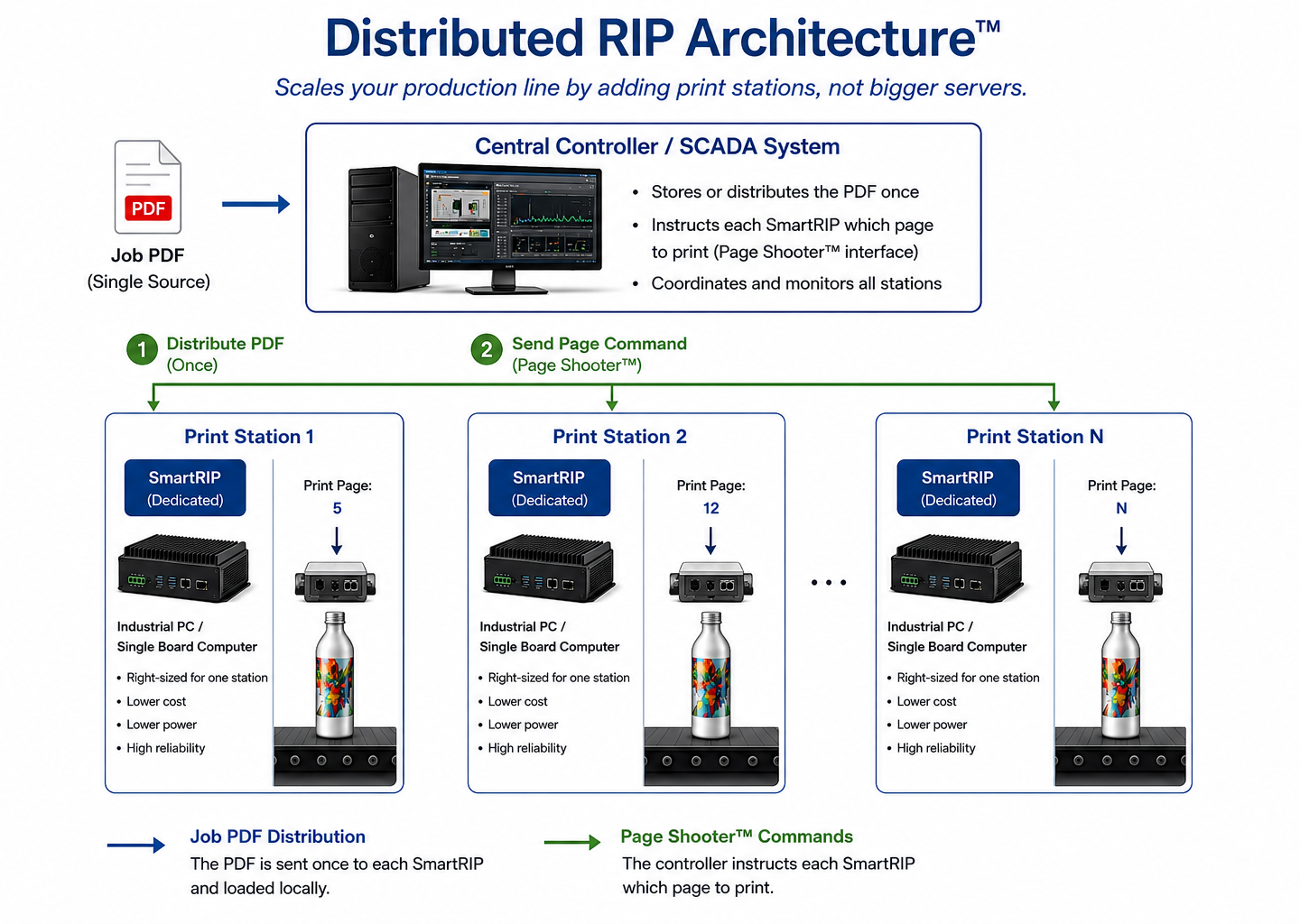
This thinking is behind the Distributed RIP Architecture™ within SmartRIP. Instead of one central raster image processor (RIP) being responsible for multiple print stations, every station has its own dedicated SmartRIP running on an industrial PC or embedded computer. A central controller or SCADA system distributes the PDF, but the processing required by each print station takes place locally. If another print station is subsequently added to the production line, it brings its own RIP capability with it.
This changes the scaling equation. Rather than asking how much more powerful the central server needs to become, each print station only requires sufficient computing power for its own workload.
The result is much more predictable scaling. Adding another station adds both production capacity and the processing resource needed to support it. It can also make lower-cost industrial computing hardware a practical option because an individual computer does not have to carry the processing requirements of the entire line.
Resilience matters too
There is another consideration that becomes increasingly important as print becomes part of manufacturing: fault isolation.
In a highly centralized architecture, a problem with a central resource can potentially have consequences elsewhere in the system. Distributing processing between print stations creates greater independence between them. That doesn’t eliminate the need for careful system design, but it does mean that the architecture itself can provide better fault isolation. For industrial environments where uptime and predictable production are critical, that’s an important consideration.
Designing print for manufacturing
Perhaps the bigger point is that industrial inkjet shouldn’t necessarily inherit all the architectural assumptions of conventional digital printing. Print is increasingly becoming another process within an automated manufacturing line, communicating with controllers, databases, inspection systems and other production equipment. The software architecture supporting it therefore needs to fit into that environment.
SmartRIP’s Distributed RIP Architecture is one example of this change in thinking. It replaces the idea of continually scaling a central DFE with a model in which processing capacity grows alongside the production line. As industrial inkjet expands into more manufacturing applications, perhaps the question won’t be “How big does our DFE need to be?” It will be “Where does the processing need to happen?”
Find out more about SmartRIP.
About the author

Eric Worrall leads the product management and technical services teams, as well as being responsible for the product strategy, position and vision within Helix. He has a wide experience of key roles including senior software developer, technical support, sales and product management, and has over 25 years of market knowledge in printing, digital documents and machine vision technologies.
Be the first to receive our software release updates, blog posts, company and product news. Why not subscribe to our newsletter? Subscribe here